
Wild About Cities
Finding nature in unexpected places

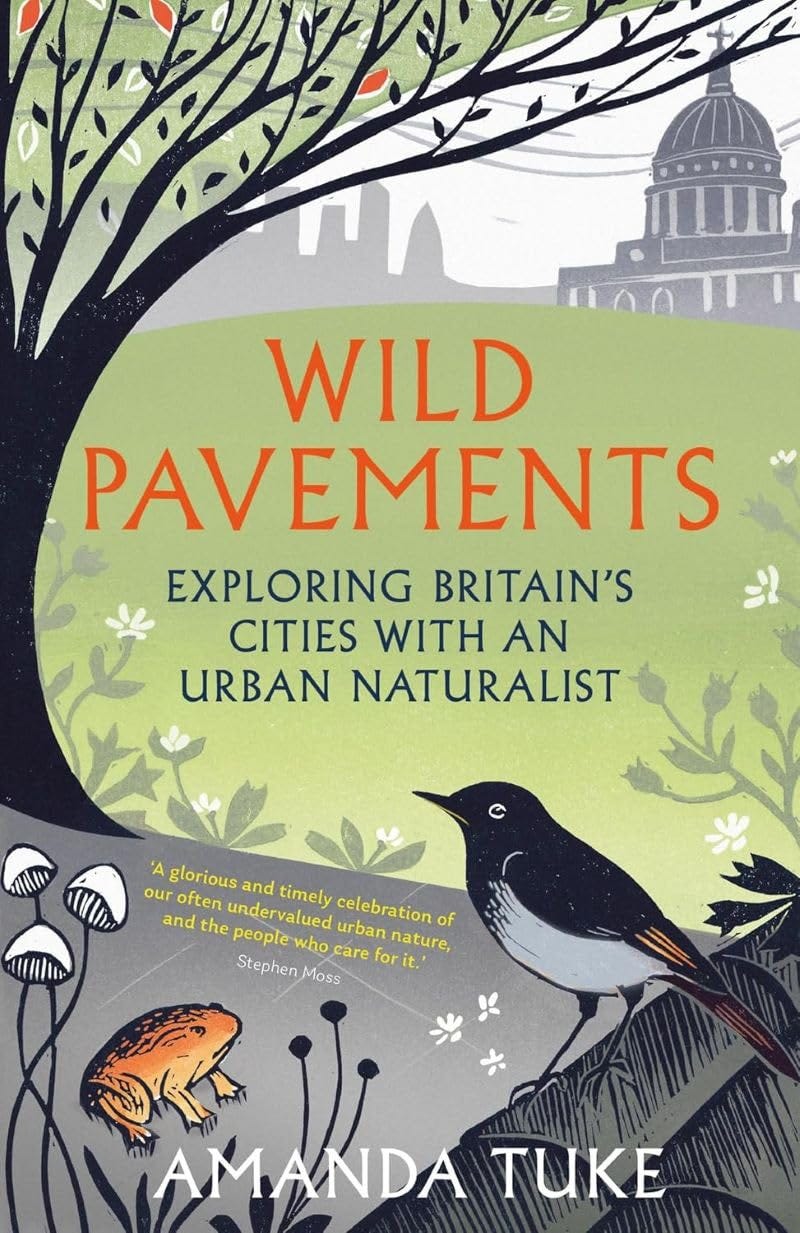
On Tuesday I attended the launch of Amanda Tuke’s book Wild Pavements at Stanfords, the map and travel bookshop in Covent Garden. I should declare an interest here: Amanda is a fellow volunteer with the London Wildlife Trust, and we share a literary agent.
Although the central theme of the book is the wild plants that adorn our pavements, Amanda, who writes a regular column for Bird Watching Magazine, soon finds her attention drawn not just to plants but to the mammals, birds, fish and fungi that inhabit our cities. But then they are all interconnected: plants provide food for birds and insects, and are pollinated by them in return.
Written in a friendly, conversational style, the book starts dramatically as she walks along a busy South London road to collect the car from the garage when a sparrowhawk zooms through the gridlocked traffic in pursuit of a great tit. Outside her suburban house, she sees tiny, flame-headed firecrests, and a buzzard pursued by a squadron of parakeets. In St Paul’s churchyard, in the very heart of the city, she hears the fluting song of a blackcap.
She circles London clockwise, identifying plants growing on pavements, walls, road verges, tree pits and building sites, meeting urban botanists, birdwatchers, park rangers and environmental activists, who share their knowledge and enthusiasm, and travels to Edinburgh, Sheffield, Cardiff, Newcastle, Belfast, Liverpool, Aberdeen and, in a final chapter, Berlin.
Weeds are simply wildflowers growing where someone thinks they shouldn’t, and many she identifies flourished in England’s fields and meadows before they were drenched in pesticides or over-fertilised – too rich a soil favours tough, nitrogen-loving grasses that outcompete more delicate species. Their names conjure a litany of rural lore: sweet violet, mouse-ear, ivy-leaved toadflax, common whitlow-grass and thale cress. I must confess that many of these are unfamiliar to me, but I will now be obstructing other pedestrians as I bend down to identify anything growing on the pavement with the plant app on my phone.
Then there are non-native plants whose seeds have arrived in shipments of wheat and other cargo, and those we have introduced ourselves, such as Oxford ragwort. Indigenous to the volcanic gravel of Mount Etna, it was cultivated in that city’s historic Botanic Garden in the 18th century. From there it spread along the ancient college walls, but didn’t really take off until the coming of the railways, which carried its fluffy seeds to every corner of the UK.
Many people, both private individuals and those in authority, see nature’s profusion as a sign of neglect, and some councils still scalp road verges and spray their pavements with glyphosate. We need to reconsider our mania for tidiness and embrace the delicate blooms that sprout from the cracks in tarmac and concrete in defiance of our efforts to suppress them. This upbeat book reminds us that we are never far from nature, and can find it amid everyday activities such as a trip to the supermarket or waiting for a bus:
‘Come to terms with the fact that the natural world is the one we live in too, expect nature to be wherever you are, and you’ll start experiencing our cities completely differently.’
Amanda Tuke, Wild Pavements: Exploring Britain’s Cities With an Urban Naturalist (Flint, 2026)
Anagram (Evolutionary landmark): Theorising of Pieces (answer below)
From our kitchen table
Adam Weymouth, Lone Wolf: Walking the Faultlines of Europe (Hutchinson Heinemann, 2025)
Adam Weymouth explores a more dramatic, high-stakes interaction between nature and the human world as he follows the trail of a young wolf whose thousand-kilometre journey from Slovenia to the Italian Alps was tracked by GPS in 2011. Along the way, he meets both environmentalists keen to restore the balance of nature by reintroducing apex predators and farmers whose flocks are threatened by their reappearance. As climate change alters the landscape and migrants are also on the move, Weymouth examines the tensions between globalisation and populist nationalism, and between the rewilding movement and the desire to preserve traditional ways of life. The result is a powerful appeal for coexistence, both human and between species.
Philip Pullman, Grimm Tales for Young and Old (Penguin, 2012)
In a previous Substack, we reflected on the perennial popularity of the tales collected by the brothers Grimm in the early 19th century. Part of the reason the return of wolves stirs such strong emotions for and against is that even though most of us have never seen one in the wild, they stalk our collective unconscious as both dangerous and charismatic thanks to these stories, and those collected by Charles Perrault more than a century earlier. ‘Wolves are sexy,’ Philip Pullman remarks in his notes on ‘Little Red Riding Hood’ in his modern retelling of 50 of the Grimm brothers’ tales.
Italo Calvino, Italian Folktales, trans. George Martin (Penguin Modern Classics, 2000)
Our kitchen table has been all wolf talk: Pullman, the Grimm brothers, Perrault, Angela Carter, Fantasy at the British Library and a keepsake Hans Andersen with Anna Ancher memorabilia at Dulwich Gallery shop. Little Red Riding Hood costumes for Book Day at the local school. But Italo Calvino takes us back to the Italian tales he intended to equal the Grimms’ Kinder-und-Hausmärchen by representing every region of Italy. We share ‘Uncle Wolf’, the tale of a ‘greedy little girl’ who can neither knit nor control her appetite, but when she eats Uncle Wolf’s pancakes and bread, downs his wine and attempts subterfuge, he gobbles her up. ‘The Wolf and the Three Girls’ tells of three sisters carrying baskets through the forest to their sick mother. One is brave enough to challenge the wolf and is eaten, but then rescued whole by brave villagers with pitchforks. We recall one of our nieces asking, ‘What’s all that about?’
Answer: The Origin of Species