Snowbound
A chilly Britain on the cusp of change
There is a strong tradition of fiction set amid extreme weather events in the UK. Graham Swift’s Waterland draws on the floods that devastated eastern England in 1947 and again in 1953. Ian McEwan’s debut novel The Cement Garden is set during the 1976 heatwave, while the great storm of October 1987 forms the backdrop to A. S. Byatt’s Possession and features in W. G. Sebald’s The Rings of Saturn.
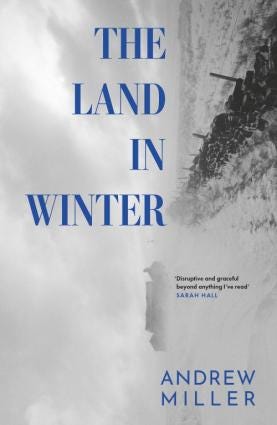
I am just old enough to remember the ferocious winter of 1962–63, when heavy snowfalls brought the UK to a standstill, and can still visualise my father shovelling aside a snowdrift to get the car out of the garage. The ‘Big Freeze’, as it was known, forms the setting for the latest addition to this select canon, Andrew Miller’s tenth novel, The Land in Winter, which was shortlisted for the 2025 Booker Prize and, having just slipped past the 60-year time limit for qualification, won the Walter Scott Prize for Historical Fiction.
Andrew Miller came to address our last Authors’ Club lunch before Christmas, and I found myself engrossed in the novel over the holiday. Set in a Somerset village isolated by heavy snow, it concerns two married couples, Eric Parry, a country GP, and his wife Irene, exiled from a literary life in London, and their neighbours Bill and Rita Simmons. The son of a wealthy slum landlord, Bill is struggling to forge an independent life as a dairy farmer, while Rita is a former showgirl with a troubled past. Both women are pregnant, and Eric is conducting an affair with the wife of a local businessman. In the forbidding county asylum, a young man is found dead, a tragedy that will cast doubt on Eric’s professional competence and integrity.
With roads and railways impassible – Irene can phone her sister in the USA but can’t reach the village shop – isolation and claustrophobia ramp up the tensions in both marriages. A brief thaw allows the Parrys to go ahead with their long-planned Boxing Day party, a scene of excruciating social comedy that forms the novel’s centrepiece. Then the snow and ice return, and the narrative moves with increasing momentum to its violent denouement.
The Land in Winter is a traditional realist novel in the best sense: socially grounded, meticulously observed, beautifully crafted and psychologically insightful. Even secondary characters, such as Frank’s Central European colleague Gabby Miklos and Rita’s Bristol nightclub friends Gloria and Byron, have deftly suggested pasts. The period detail – cars, cigarette brands, food, films – is authentic, but never overdone. The social attitudes are also redolent of the era: everybody smokes, no one thinks twice about driving a car after several drinks, and snobbery, misogyny and racism are unquestioned.
Setting and characters combine to form a convincing panorama of Britain on the cusp of social change in the aftermath of the Profumo scandal, while the trauma of the Second World War – more recent then than 9/11 is now – still casts a long shadow. In this world of shifting moral certainties it seems, as Philip Larkin observed sardonically in his poem Annus Mirabilis, that ‘Every life became/ A brilliant breaking of the bank,/ A quite unlosable game.’
But as Miller’s snowbound quartet discover, every game has losers as well as winners.
Andrew Miller, The Land in Winter (Sceptre, 2025)
Anagram (Scottish novelist): Misrule Park (answer below)
From our kitchen table
Christopher Somerville: Walking the Bones of Britain (Penguin, 2024)
The veteran Times walking correspondent travels the length of the British Isles through ever younger layers of geology, from the 3-billion-year-old Precambrian gneiss of the Isle of Lewis to the shifting sands of the Thames Estuary. I was a little daunted by the unimaginable timespans and geological terminology, as Somerville endearingly confesses he was himself (he helpfully provides a glossary). There is some beautiful nature writing, and I was interested to learn how the underlying geology influences the species of wildflowers that grow in a particular place, such as rare arctic-alpines on the sugar limestone of Upper Teesdale. I was also intrigued by the career of the great Edinburgh geologist James Hutton, whose understanding that the collision of tectonic plates and the upsurge of volcanic magma could disrupt and even overturn layers of sedimentary rock was resisted by the scientific establishment until after his death.
Maya Angelou and Burns
Speaking of Somerville walking through Scotland, and delighting in a family wedding invitation to Ayrshire, our kitchen table talk wandered to Burns Night and a recent (24 January 2026) television programme where Andrew O’Hagan reviewed the makar’s life, writing, and decisions about work, including the one where Burns decided not to leave Scotland for work in Jamaica. O’Hagan was followed by a programme from 1996 in which Maya Angelou travelled to a Burns Night in Scotland. Angelou enthusiastically claimed Burns’s influence, participated in readings and song, explained how his passionate concerns with social inequality, poverty, liberty and language transcended barriers. Insistent and impressive, after listening tearfully to a rendering of ‘Wantonness’, she determined it would never leave her. It was a pleasure to share her passion – we can only wish you and your loves the best this week and ‘Till a’ the seas gang dry, my dear, And the rocks melt wi’ the sun.’
Ian Crofton: A Dictionary of Scottish Phrase and Fable (Birlinn, 2021)
Burns night naturally features in this huge alphabetical compendium of Scottish customs, legends, folklore, sayings and, of course, insults. We learn that the former UK Prime Minister is known as ‘Broon, The Misery from the Manse’, while the inflated costs of the Scottish Parliament building led to its being dubbed Follyrood. The 4500 entries in this expanded edition range from the erudite to the irreverent – Mary Queen of Scots’ Casket Letters and the Scottish Enlightenment sit between the same covers as the late, great Stanley Baxter’s legendary sketch Parliamo Glasgow and the old playground song ‘Ye cannae shove yer granny aff a bus’.
Answer: Muriel Spark