
Lovers at War
Troilus and Cressida at Shakespeare’s Globe

It’s Notes in the Margin’s first anniversary this week. To celebrate, I’m offering a 20% discount on subscriptions – that’s just £2.80 a week or £28 a year – for one month only. A paid sub will give you access to all paywalled content and the full archive, and allow you to join the conversation by posting comments.
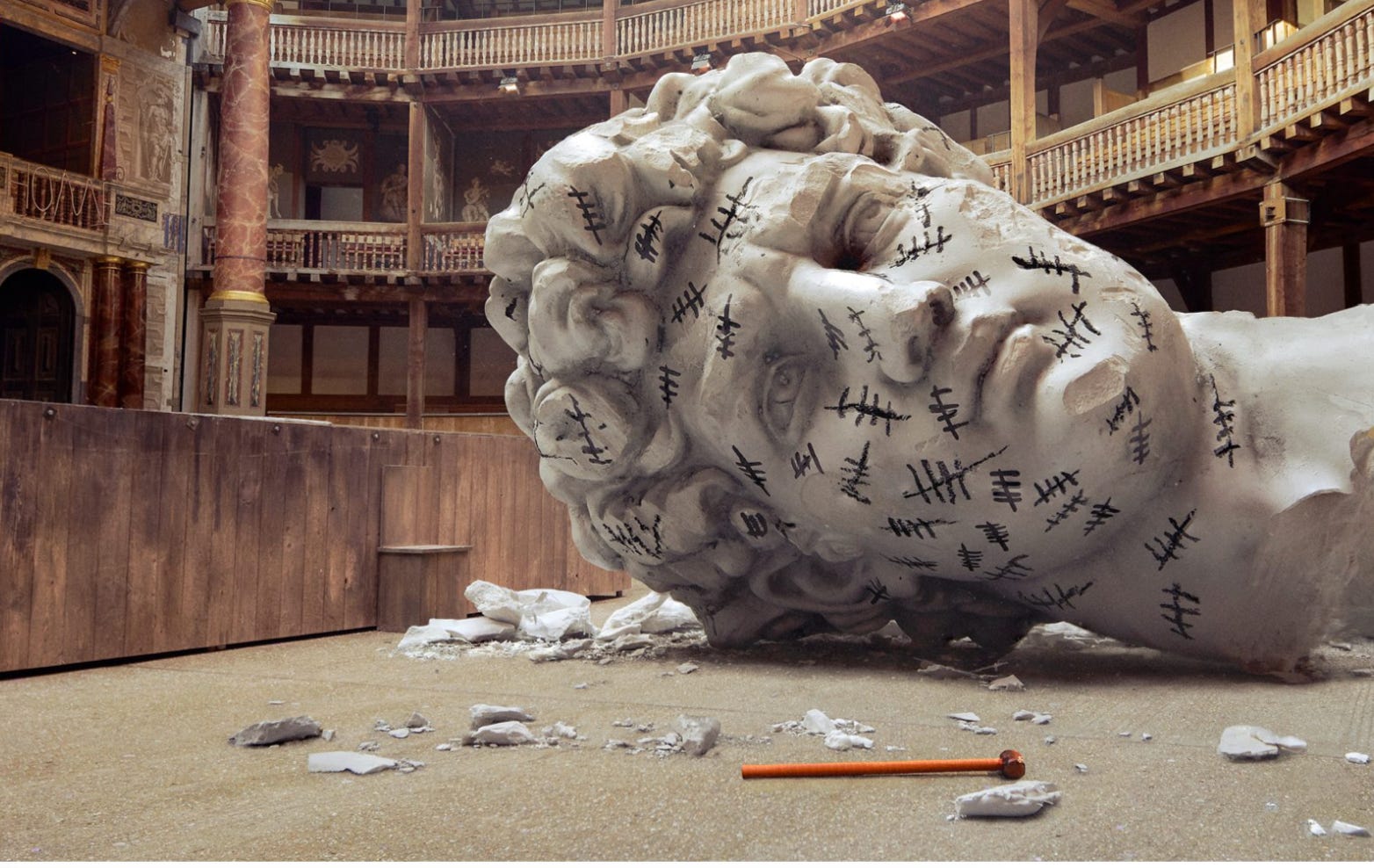
Last week we went to see Troilus and Cressida at Shakespeare’s Globe, in a spirited, slimmed-down if somewhat incoherent production by Owen Horsley. But then it’s an odd drama, considered by some critics as one of Shakespeare’s ‘problem plays’. Though it is titled ‘The Tragedy of Troilus and Cressida’ in the first quarto of 1609, the eponymous lovers – played by Kasper Hilton-Hille and Charlotte O’Leary – are very much alive at the end, and their story seems almost a subplot in what might more accurately be called ‘The Tragedy of Hector and Achilles’.
Homer’s Iliad provides the Trojan War background to the play, but the central romance derives from later elaborations by Boccaccio and Chaucer, among others. Troilus, a Trojan prince, falls in love with Cressida, whose father has defected to the Greeks. When Cressida is sent to the Greek encampment in exchange for a Trojan prisoner, she swears eternal love for Troilus, but soon becomes involved with the Greek officer Diomedes.
Meanwhile, Troilus’s brother Hector (a convincing Oliver Alvin-Wilson) challenges the Greeks’ mightiest warrior to single combat – but Achilles, played by an impressively muscled David Caves (yes, him off Silent Witness), is sulking in his tent and refuses to fight. Only after Hector kills Achilles’ lover Patroclus does the Greek champion take up arms again, and he and his troops slay Hector. Troilus then swears revenge for his brother’s death and Cressida’s betrayal, and the war grinds on relentlessly.
There are a few gender changes in this production, since apart from Cressida herself, the play has only two female characters, Helen and Cassandra, and they don’t have many lines (the role of Andromache, along with Priam and Aeneas, has been cut in this version). Cressida’s pimping uncle Pandarus becomes less seedy and more sympathetic as a matchmaking auntie in an engaging performance by Samantha Spiro. Thersites (‘a deformed and scurrilous Grecian’) who functions as a kind of chorus is played as a hyperactive stand-up comic by Lucy McCormick, who doubles as a vampish Helen of Troy. In a plausible reinvention, Cassandra (Jodie McNee, who doubles as Ulysses), fated to foresee the future but never be believed, becomes a parka-clad, megaphone-wielding activist predicting the destruction of Troy.
What to make of it all? This gutsy modern-dress production of a difficult play with few sympathetic characters draws on Brechtian and agitprop theatre to bring out its satire on militarism and masculinity. As the cynical Thersites proclaims in Act V: ‘Lechery, lechery; still, wars and lechery: nothing else holds fashion. A burning devil take them!’
Troilus and Cressida is playing at Shakespeare’s Globe in London until 26 October.
Anagram (Victorian novel): Hell, Not Selfish Tom (answer below)
From our kitchen table
Ben Markovits, The Rest of Our Lives (Faber & Faber, 2025)
I heard Ben Markovits talk about his latest novel at an Authors’ Club lunch back in May, but only recently got round to reading it at leisure. The Rest of Our Lives has now been shortlisted for the Booker Prize, and deservedly so. Its narrator Tom Layward is a middle-aged law lecturer who, after taking his daughter to university in Pittsburgh, decides to leave his wife and keeps on driving. The novel deftly elides three genres: suburban marital drama, the campus novel, and the road trip. In springy, conversational prose in the best American tradition of Updike, Malamud and Bellow, it gradually reveals that Tom has been suspended from his university post after complaints from students, and is in denial about his ominous health symptoms.
David Henry Thoreau, Walden, Civil Disobedience and Other Writings, ed. William Rossi (Third Norton Critical Edition, 2008)
‘The best thing about Boston,’ Tom Layward remarks in The Rest of Our Lives, ‘is how easy it is to get out of it. Half an hour later, you’re at Walden Pond.’ David Henry Thoreau is probably best known for his account of his time living in a cabin on Walden Pond, a text intended to ‘wake my neighbours up’ from their ‘lives of quiet desperation’ and elevate life by a ‘conscious endeavor’. In recent times his works have become highly regarded for their engagement with environmental, social, cultural and political questions; the critic Lawrence Buell describes him as the ‘first American environmentalist saint’ for his celebration of nature and wilderness. In this edition, Walden is paired with his essay Civil Disobedience, which led to thoughts about the timeliness of his ideas about government, in particular, an American government ‘endeavoring to transmit itself unimpaired to posterity, but…’. Thoreau can simultaneously enthral, distance a little, amuse and engender respect within pages. He is always a recommended read. What can an aspiring writer learn from Henry David Thoreau? Try this video from the Thoreau Society.
Christopher Clark, A Scandal in Königsberg (Allen Lane, 2025)
Not long ago I attended the launch of Christopher Clark’s A Scandal in Königsberg, at which the author was adeptly interviewed by the German historian Katja Hoyer. This short, gripping history tells how, in the 1830s, the unorthodox theology of two Lutheran pastors, Johann Ebel and Heinrich Diestel, alarmed the Prussian authorities, while their charismatic preaching won them a wide following, especially among women. This laid them open to accusations of conducting orgies and sexual initiation rites. In a classic case of ‘who smelt it, dealt it’, their two main accusers turned out to be a lecherous aristocrat and a doctor notorious for molesting female patients. Both clergymen were eventually acquitted of the sexual charges, but their reputations and careers were ruined. Königsberg itself was flattened by RAF bombers and captured by the Soviet Army at the end of the Second World War, and is now capital of the Russian exclave of Kaliningrad.
Answer: The Mill on the Floss, by George Eliot