
A Deadly Game
Stefan Zweig's last novella, 'Chess'

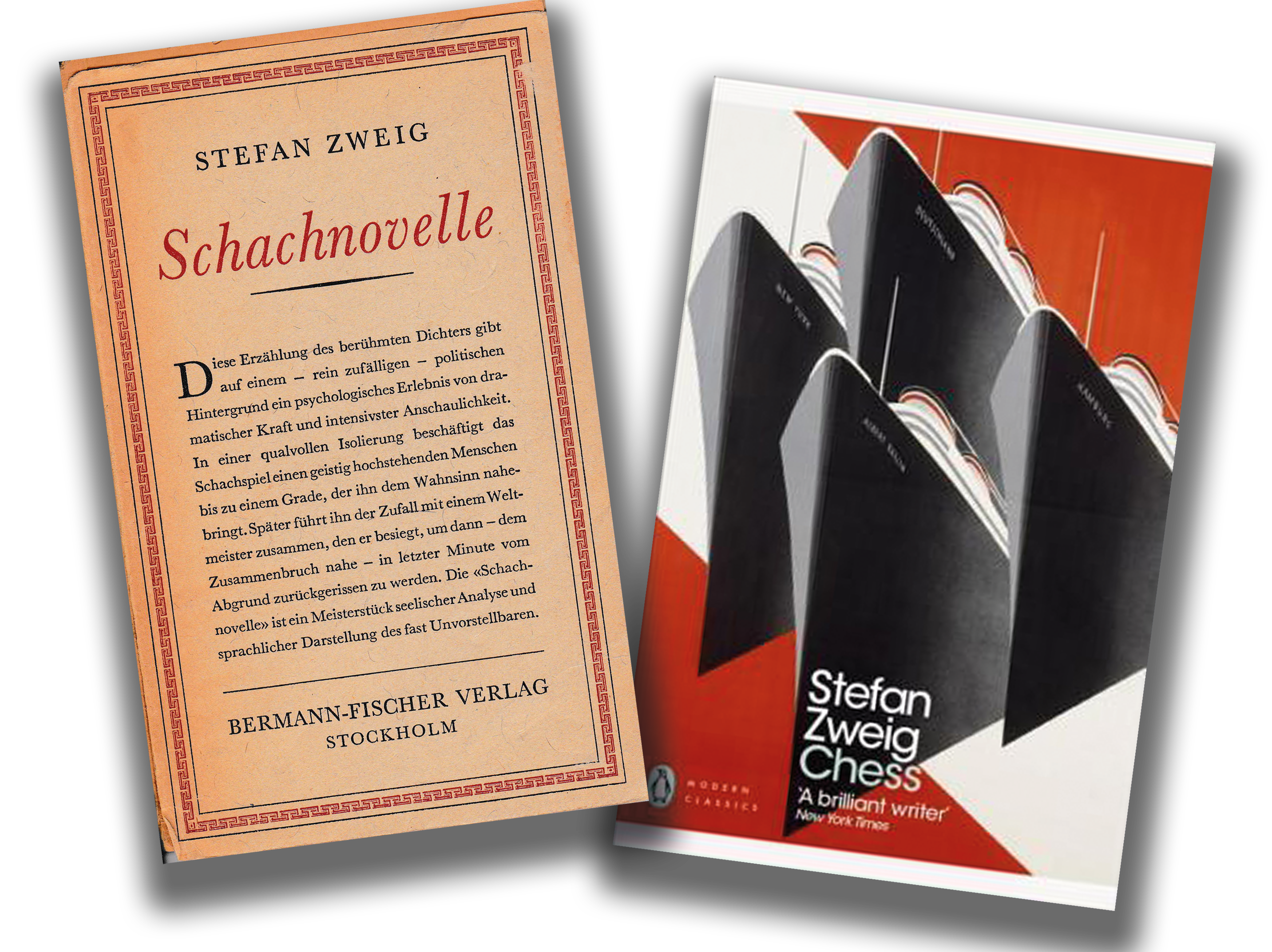
Among a handful of books I inherited from my grandparents was an attractive softback edition of Stefan Zweig’s Schachnovelle, published by Bermann-Fischer in Stockholm in 1945. (The German title – literally ‘Chess Novella’ – has been variously translated as The Royal Game, Chess Story and simply Chess.) On the flyleaf is my grandmother’s signature and the inscription April 27, 1951, New York.
Like many of Zweig’s stories, Chess employs a framing narrative. The unnamed, first-person narrator boards an ocean liner bound from New York to Buenos Aires. The flashbulbs of the press alert him to the presence among his fellow passengers of a chess grandmaster, Mirko Czentovic. A poor boy from a Yugoslav village, he showed little intellect or aptitude for anything until he observed the local priest and policeman playing chess and, to everyone’s surprise, swiftly mastered the game. Lured into taking on a group of chess-playing passengers, the churlish savant effortlessly defeats them all until one day, a thin, pallid, nervous-looking man begins whispering instructions, and their luck begins to turn.
Challenged, the stranger admits to the narrator that he hadn’t touched a chess piece since his schooldays, and reluctantly begins to tell his story. A lay official for the Austrian Catholic Church, he was involved in the clandestine transfer of its assets abroad to prevent their confiscation by the Nazis. Betrayed, he was imprisoned by the Gestapo in the seemingly comfortable conditions of a requisitioned hotel. But the complete lack of human contact beyond the relentless interrogations, the absence of any news from the outside world, or any books and writing material, began to erode his grip on reality. Then one day, leaving an interrogation, he noticed a book in the pocket of an officer’s coat hanging from a peg. Back in his cell, he was disappointed to find that it was a chess manual, but since it was all he had, began to read. Soon, without ever touching a chessman, he was replaying the great games of the past in his head. Once he had exhausted those, he began inventing new ones, dividing himself mentally into two opponents, each ignorant of the other’s intentions – and what began by offering to save his sanity now posed a greater threat to it…
This chilling psychological study was Zweig’s last work of fiction, which he posted to Gottfried Bermann Fischer – who specialised in publishing works by German-language authors banned by the Nazis – just two days before his suicide in Brazil. With its sense of displacement and unease, Chess remains a classic of exile literature.
Stefan Zweig, Chess, translated by Anthea Bell. (Penguin Classics, 2017)
Anagram (Novel by Hermann Hesse): Madge hates bagels (answer below)
From our kitchen table
Tom Stoppard, The Voyage of the St Louis (listen on BBC Sounds)
I was reminded of both Zweig’s ocean liner setting and its political backdrop by the recent broadcast on Radio 4, as part of its Celebrating Stoppard season, of The Voyage of the St Louis, the late playwright’s adaptation of Daniel Kehlmann’s 2018 play Die Reise der Verlorenen, based in turn on the book The Voyage of the Damned by Gordon Thomas and Max Morgan-Witts. It tells how, in May 1939, more than 900 Jewish refugees boarded the liner St Louis in Hamburg, bound for Cuba. The play gives voice to the desperate passengers, the decent Captain Schroeder, and the Nazi spy Schiendick as the ship lies at anchor off Havana before being turned back to Germany.
Hermann Hesse, Peter Camenzind, translated by W. W. Strachan (Penguin, 1973)
A local charity shop furnished an old Penguin of Hermann Hesse’s first published novel, from 1904. It’s a young man’s book, a classic, realist Bildungsroman charting his protagonist’s emotional and spiritual development. Born in a small alpine village, Peter Camenzind yearns to become a poet. Unhappy in love, he travels to Basel and Zurich, where he becomes a journalist, and to Umbria, where he follows in the footsteps of St Francis of Assisi, before realising that there is more poetry, and more divinity, in the sublime mountains of his homeland – an intimation of the direction that Hesse’s later writing would take.
Vesna Goldsworthy, Iron Curtain (Chatto and Windus, 2022)
Our kitchen table yields circuitous routes, roots, knots and cracks. This week it’s taken us from Stoppard to Hesse and thence, via a news bulletin, to the Cold War in the 1980s. The Belgrade-born writer Vesna Goldsworthy’s 2022 novel Iron Curtain is a tense, cinematic depiction of the relationship between Milena, a pampered daughter of an unnamed East European country’s Communist elite, and Jason, a confident but politically ignorant young British poet in London. The products of civilisations beyond each other’s understanding, they are unable to reconcile their conceptions of the world, and as things fall apart, she opts to return to her homeland.
Answer: The Glass Bead Game